Attachment Styles

It’s natural to want to connect with and be cared for by others, especially in relationships. The way you maintain those relationships can say which type of attachment style you have. Studies show that your relationship with your parents is influential on your attachment style. 

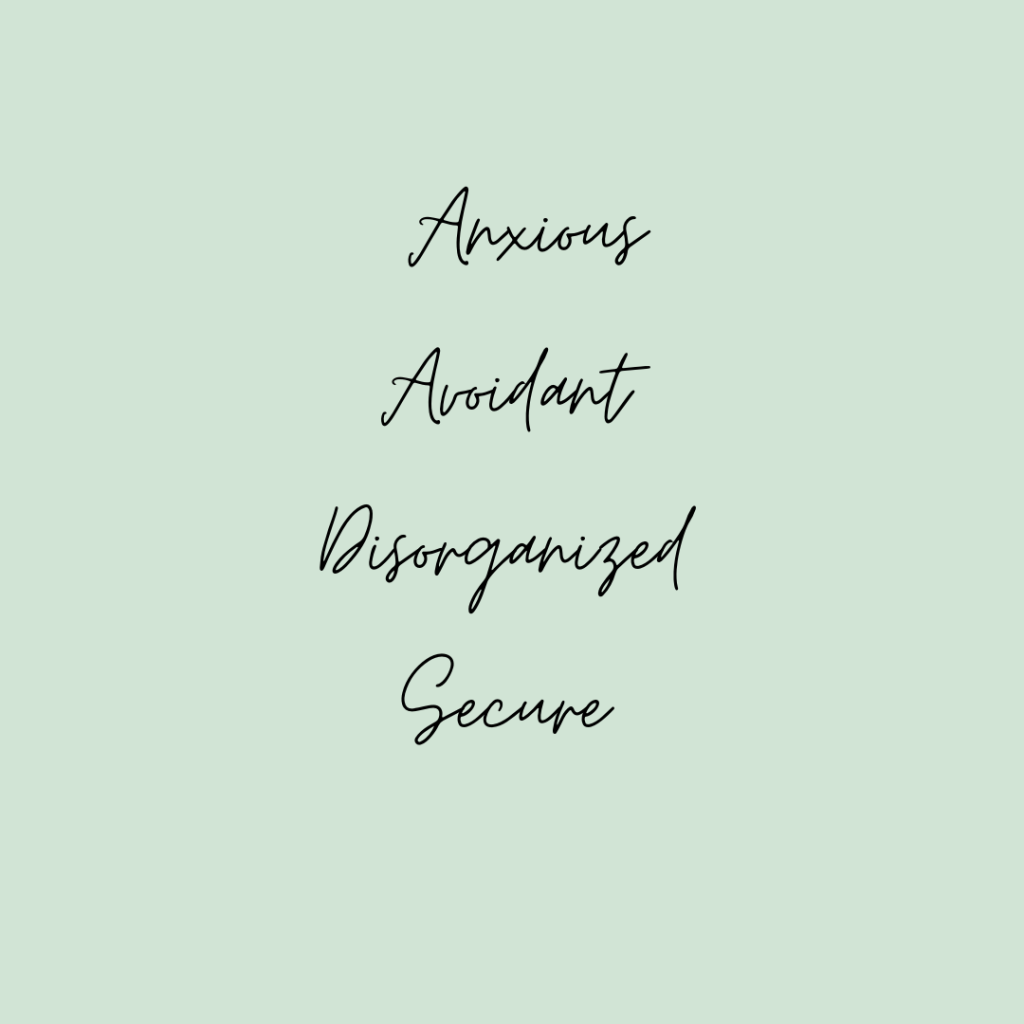
There are four types of attachment styles:

  1. Anxious (preoccupied)
  2. Avoidant (dismissive)
  3. Disorganized (fearful avoidant)
  4. Secure 

Anxious/preoccupied: you often feel that your partner is the better part of you and your relationship. The thought of being without your partner can cause you anxiety. This attachment style is most common for people with anxiety, separation anxiety, and people who have past relationship traumas. The anxious partner will often seek certain things like approval, support, and reassurance from their partner. 

Partners with this attachment style typically value their relationships but are worried they are more invested than their partner. They may also be worried that they are not enough for their partner. There is typically a fear of abandonment and they want to make feeling safe a priority. Getting the attention, care, reassurance, etc. is what helps the anxious partner feel more secure. When there is a lack or absence of this support, it typically leaves the anxious partner more clingy and demanding. 

Avoidant/dismissive: you often think of yourself as an overly independent person. You describe yourself as strong, self-sufficient, and don’t rely or depend on others. People with this attachment style typically have a higher self esteem and have positive views about themselves. They don’t believe they need to be in a relationship to feel complete. Partners with this attachment style usually try to avoid emotional bonds and try not to be vulnerable. They hide their feelings and emotions.

Disorganized/fearful: you tend to show unstable, unclear, or ambiguous emotions and behaviors in your relationships. Your partner and the relationship both are a source of desire and fear at the same time. People with this attachment style want the intimacy and closeness that a relationship brings but have a hard time trusting and depending on others at the same time. It is hard for them to regulate their emotions and typically avoid serious bonds due to them being scared of getting hurt.

Secure: you tend to be comfortable in expressing emotions which leads to you maintaining healthy relationships. People with this attachment style typically depend on their partners while letting their partners rely on them. Their relationships are based on mutual honesty, trust, and emotional closeness. While they thrive in relationships, they are also okay with being on their own. They do not depend on the approval of others and have a positive view of themselves and others. 

The first three attachment styles were insecure attachment styles, whereas the last one is obviously secure. You may relate to one more than others or have a combination of two or more styles. It’s normal to see areas of these that you relate to. Even if you are in the secure category, you may have times where you relate to one of the insecure categories, and that is normal too. If you find yourself relating to the insecure style(s) more, it may be time to address your issues and have a conversation with your partner about it. If you both feel necessary, getting professional help alone and/or together might help. Ignoring these things may lead to anxiety, depression, and other mental health issues.
Stop Apologizing For Things That Are Normal

The societal pressures that men and women face daily have become insane. It almost feels like everything you do is criticized and critiqued in some way. If someone prefers to be more natural, they are ridiculed for not caring about their looks. If someone prefers to wear makeup and have their hair done, they are ridiculed for trying too hard. We are all human and we should be able to live how we want and do what is best for us. It’s time that we stop apologizing for the things that make us us.

Stop apologizing for:

  • Not wearing makeup
  • Wearing makeup
  • Your hair not being done
  • Your nails not being painted
  • Not looking perfect 
  • Acne or breakouts
  • Having dark circles or puffy eyes
  • Having body hair
  • Not wearing heels
  • Not wearing a bra
  • Having emotions
  • Showing and expressing your emotions
  • Not wearing a fancy outfit
  • Not owning a designer bag
  • Looking tired
  • Having stretch marks
  • Canceling plans
  • Putting yourself first
  • Setting healthy boundaries
  • Saying no
  • Not driving a nice car
  • Having cellulite
  • Not eating enough
  • Eating too much
  • What you eat
  • What you don’t eat
  • Anything that makes you human

What We Should Have Been Taught For Relationships

Growing up, we always heard that relationships should be a certain way. You meet someone, you fall in love, get married, and have kids. However, there is so much more that we should have been taught. We should have been taught how to communicate feelings, what love languages are and how to love someone with their love languages, how to set healthy boundaries, attachment styles, how to maintain attraction, and more.

Learning all of these things can help you maintain healthier relationships and bring you closer to the person you are dating. Communication is one of the most important aspects of a relationship. Being able to express your feelings, thoughts, and concerns can make or break your relationship. With communication, you will be able to talk about what your boundaries are and what kind of attachment styles you both have. 

It’s important to understand your own love languages and what they mean to you as well as knowing your partners. The five love languages are words of affirmation, quality time, physical touch, gifts, and acts of service. Understanding what your top love languages are and telling your partner how they can do them best is key to understanding how to love each other. In doing this, you will help maintain attraction for each other too! 

International Women’s Day

Empowered women empower women. Today is international women’s day and March is international women’s month. This is the perfect time to thank the powerful women that are in your life and if you are a woman it is the perfect time for self love and self appreciation. Today and this month serves as a reminder to give yourself credit for how far you’ve come.

Throughout the years, women have been paving the way for future generations of women. From women’s suffrage, civil rights, producing birth control, women in space, women in politics, women in combat, and so much more, women have come a long way. Although we have come a long way, there is still a long way to go. Take this month to show gratitude for the steps that women have taken to get us where we are. 

Some ways to show your love and appreciation for women this month are:

  • Compliments
  • Donate gently used items to women’s shelters
  • Support women owned businesses
  • Read a book by a woman author
  • Watch documentaries on the history of women
  • Donate to charities that support women
  • Educate yourself on women equality and current women inequality issues

Easy Ways to Boost Your Confidence

Boosting your confidence can be hard, especially if you don’t know where to start. There are easy tricks that will help you feel more confident quickly and easily which will lead to a long-term confidence increase. 

  1. Speak in a consistent speed

People with a lack of confidence typically talk very quickly or very slowly. When people talk quickly they typically do not feel they deserve to be listened to and want to be done speaking as soon as they can. Whereas people who speak very slowly feel they need to find the perfect words in order to be heard. 

  1. Change your walk

Walk faster with your shoulders back and head lifted to feel more confident throughout the day.

  1. Dress nice

When you look good, you will feel good. I have a saying with my friends where we say, “look good, feel good, do good.” I have found this to be true in my own life. 

  1. Set and accomplish small 

Setting small goals for yourself, like making your bed every morning, will give you a sense of accomplishment leading you to feel better about yourself.

  1. Learn new skills

When you learn new skills it will help empower you and have you building your skills along with building your confidence.

  1. Position yourself

Where you position yourself in a room, when talking to people, etc. will help build your confidence. It can be intimidating at first but will help long-term. Be in the front seat, sit/stand directly in front of the person you’re talking with. Position yourself for confidence. 

Productivity Hacks

Maximizing time and efficiency can be a difficult thing to do. Research has shown that there are certain hacks to help you become more productive, if done correctly. 

Here are some of my favorite productivity hacks:

  1. Focusing on one task at a time rather than trying to multitask

Multitasking typically has a negative effect on someone’s productivity. You lose more time trying to switch between tasks than you would by completing one before moving onto the next. The more tasks you try doing at once, the more your productivity goes down.

  1. Block your distractions

It isn’t always realistic to put your phone away completely, so limiting your notifications may be the next best thing. You can mute notifications such as social media, friends, etc. Then you will still get notifications you need like emails but you won’t get distracted by others. 

  1. The Pomodoro Method

This is a simple way to ensure you have productivity time and time to give your mind a rest. The first thing you do is pick which task you want to do first. You will do 25 minutes of focused work then 5 minutes of break time. It might help to set a timer to begin with so you can stay on track. You will repeat this throughout the day. After every 4 pomodoros, take a 15-30 minute break. This helps you manage your time management and productivity. 

  1. Practice Grouping

Grouping similar tasks together helps your productivity as well. For example, grouping together all of your administrative work such as emails, phone calls, messages, etc. into a certain time frame before moving on to other types of tasks will help. From there, you could move on to managing your social media accounts, then researching, etc. 

  1. Plan your day

Making a to-do list will help keep your thoughts organized as well as reduce anxiety about the day. Seeing your tasks will help you group them together and decide on a strategy to complete them. This helps you maximize your time and efficiency. 

Anxiety Triggers & Anxiety Soothers

One thing that people don’t always understand is that anxiety can be brought on by certain triggers as well as being a day-to-day struggle. It is common for people with anxiety to have good and bad days. In a previous blog, I talked about how healing is not always linear. You may be having a good day and managing your anxiety well and then a trigger can hit. 

Some common anxiety triggers can be:

  • Past trauma
  • Life transitions
  • Relationship conflicts
  • Negative beliefs
  • Health concerns
  • Alcohol and drugs
  • Difficulty sleeping
  • Bullying
  • World events
  • Stressful work environments
  • Changes
  • Racism
  • Finances
  • Responsibilities 

Some anxiety soothers can be:

  • Spending time outdoors
  • Setting boundaries
  • Self-compassion
  • Mindfulness
  • Meditation
  • Hydration
  • Consistent sleep
  • Exercise
  • Recognizing your worth
  • Connecting with friends and family
  • Balanced nutrition
  • Deep breathing

When Should You End a Relationship?

If you are contemplating ending a relationship, keep reading. Especially if you are new to relationships or are in your first long term relationship. 

When you feel like the sparks are gone, are they really? Or has your relationship transitioned into a new phase? People often have “butterflies” when they start relationships because it is new and exciting. While this can be referred to as the honeymoon phase, it lasts for different lengths of time for everyone. Just because you don’t get the same butterflies, doesn’t mean your relationship is done. It usually just means you have entered the next phase of your relationship where you have different needs.

Do you feel like your conflicts are stuck in a vicious cycle? Or are you not understanding your core differences? Research has shown that about 70% of relationship conflicts are repeats. This means that in most relationships, the arguments are fundamentally the same and often about the same topics. Conflict is normal, especially if they are coming from a difference of personality or lifestyles. It only matters how you both handle the conflict, how you discuss the issues, and how you work together to resolve them. 

Are you not getting what you need from the relationship? Or are you not telling your partner what it is you need from them? Oftentimes, people expect their partners to know how to love them and what they need. This is not the case. No one is able to read each other’s minds. We grew up differently and viewed relationships in different styles. You will be disappointed if you assume your partner knows everything you need all the time. This is where communication comes into play. Asking them for what you need is a much better way to help each other. 

Do you feel distant from them? Or have you stopped making time for each other and the relationship? You often hear that relationships require work, and they do. But the work should be paying attention to details, planning things, being intentional with your words and actions, learning your partner’s love language and understanding how to give that to them. Checking in on your partner and making time for them are simple ways that can bring you closer together and keep that distant feeling away.

Are you unhappy with your partner/relationship? Or are you unhappy with other aspects of your life? There are many things that can play a part in your personal life that affect your mood. These factors can be depression, anxiety, life transitions, financial problems, etc. Sometimes they translate into our relationships. If you find you are struggling with some of these, try talking to your partner about what is going on and how you would like them to help you through it. 

Understand that your friends, family, therapist, etc. can all give you support, however, only you will know where you stand in your relationship. If you know in your heart that you are no longer happy, it is not fair to you or your partner to continue the relationship. Some people are simply not meant to be and that’s okay. Eventually, everyone will find their person. 

Rest is Not a Reward

Oftentimes, people believe they need to earn their rest. They might say “I’ve worked hard this week, I deserve to rest this weekend,” but the truth is, you should simply say, “I deserve to rest.” You, as a human being, deserve to have rest. And you need it! You shouldn’t feel guilty or feel the need to justify taking the time to rest. 

It is important to know which type(s) of rest you need. There are 7 types of rest: 

Creative Rest- taking time to reignite your creative spark. This can be relaxing activities such as coloring, painting, reading, or simply watching a show/movie that gets your imagination going. 

Mental Rest- one of the best ways to do this is to schedule time to take a break. If you are at work you can try scheduling a 10 minute break every couple of hours. During this time you can take a walk, eat a snack, or whatever will help you relax for a bit. 

Physical Rest- there are two types of physical rest. Passive, which is resting or sleeping. And active, which is doing things like meditation or yoga. 

Social Rest- a social rest deficit often comes from hanging out with people too often, for too long, or being with the wrong people. Take some time to think about who in your life is good for your wellbeing and who is not. Decrease your time with the people who are not good for your wellbeing and continue spending time with the people who are good. If you have spent a lot of time around people lately, try taking a day to yourself to recharge.

Emotional Rest- being the person that everyone seems to go to and rely on can be very tiring, especially if you have a hard time setting boundaries for yourself. If you find yourself not wanting to talk to someone or feeling unable to help, it is okay to put yourself first and say no. It is okay to say no to talking, hanging out, going out, etc. to take care of yourself.

Sensory Rest- you hear all the time to unplug once in a while but how often do you actually do it? It is important to get sensory rest since there are constantly things going on around you whether you notice it or not. Lights, screens, background conversations, typing on a keyboard, etc. are things that seem to be nonstop. Taking time to literally unplug, turn off the electronics and lights, and sit or lay down for a while can give you the sensory rest your body needs. 

Spiritual Rest- getting spiritual rest is reconnecting. Whether it’s reconnecting in a religious sense, to nature, or to others, it is important to take the time to do so. Try going to a church, take a nature walk, or volunteering. 

Signs Your Mental Health is Getting Bad Again

Something that a lot of people don’t understand is that healing is not linear. If you are struggling with depression and/or anxiety, you are going to have good days and bad days. It is completely normal to have a bad day, even after having a good stretch of days. While it is normal, it is still important to recognize when you are getting bad again. 

Here is a list of signs that your mental health is getting bad again:

  • Your energy levels have decreased
  • You are more irritable than usual
  • You are sleeping more or less than usual
  • Everything begins feeling like work or a chore- including hobbies
  • You feel trapped
  • You have a more negative outlook
  • You are having a hard time engaging
  • You snap at others
  • Your confidence goes down
  • Your self-image changes
  • Feeling unhappy right when you wake up
  • Feeling overwhelmed
  • You become more defensive
  • You do more mindless activities (scrolling social media, watching tv, etc.)
  • You start prioritizing short term pleasure over long term gain
  • You avoid making future plans and begin bailing on current plans
  • Listening to music isn’t fun anymore
  • Sensing a lack of purpose/inspiration/goals
  • Seeking out triggering content on purpose
  • Your living space gets messier
  • You find it hard to leave your home
  • Small things feel like big things
  • You find yourself reliving the past instead of focusing on the present
  • You begin using alcohol and/or drugs to cope

What to do when you recognize these signs of your mental health getting bad again:

  • Talk to someone you trust- this can be a friend, family member, therapist, or even calling a helpline
  • Give yourself time to start healing again- take a mental health day and do what you think will help you get out of your funk
  • Take care of your body- make sure you are still eating and drinking plenty of water
  • Exercise- try cardio or meditation
  • Eat better- when you put bad food into your body, you can’t expect to feel good
  • Surround yourself with things and people that you love- this can be friends, family, pets, etc.
  • Force yourself to do your hobbies again- even if you don’t think you have the energy or desire to do so, once you start it can put you in a better mindset
  • Take a shower- this may seem simple to some people but it is not uncommon for people dealing with depression and anxiety to not take care of themselves
  • Take a bath- showering may seem too difficult, try taking a relaxing bath instead
  • Go outside- getting fresh air can be an immediate mood change for some people and it forces you to move your body
  • Avoid alcohol and drugs
  • Unplug from social media and tv
  • Remind yourself that nothing is permanent and you will not feel like this forever

Resources: Phone Number: 1-(800)-662-HELP (4357)

MentalHealth.gov: This website provides information about mental health disorders and available treatments.

National Suicide Prevention Lifeline: 800-273-8255